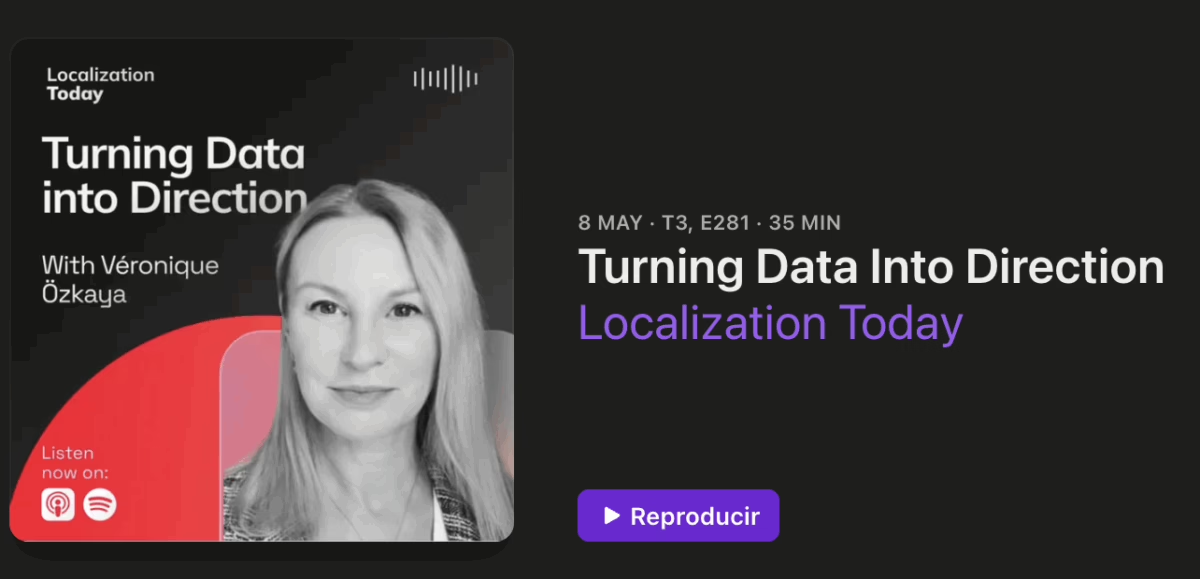
Our co-CEO, Véronique Özkaya, was invited to the Localization Today Podcast, where she was able to explain the rebrand and talk about Turning Data into Direction.
Let’s dive right in with Veronique.
The Rebrand
We still get questions about that. Some wonder if we’re a new company in the data space, and others wonder if we’re still a languages company too. It’s all of the above, and more. We started the journey toward this rebrand, which happened earlier this year, some time ago. It started with strategic acquisitions.
- GlobalMe in 2019, which added audio/data collection services
- Datamundi in 202,0 which added a data-services platform and expertise in dataset cleaning, enhancing, and “fit-for-purpose” prep.
In many ways, these acquisitions anticipated the AI wave before ChatGPT came on the stage. But along the way we realized our name and brand no longer reflected who we’d become with the addition of data services. Thanks to our CMO, Kathleen Bostick, who pointed out that we already owned the perfect name, we rebranded into DATAmundi.ai. Kathleen was also instrumental in getting our domain name purchased and important paperwork started.
With the Rebrand We Pivoted
- Boosted our sales and training on services, use cases, and client discovery.
- Operations retraining and shifting people to the data unit.
- Tech process:
- AIDA platform evolves to meet client needs
- Tech alignment across sales, ops, and talent
- Talent challenge we’re meeting. Sourcing curated crowds and highly specialized SMEs, including domain experts + linguists
Multilingual Content is a Strategic Asset
We’re seeing that many of our traditional localization clients are, in fact, sitting on a gold mine of multilingual data. Beyond translation the information they have can be used to:
- Train/align AI systems and internal assistants.
- Produce insights – e.g. improving product descriptions to help sales.
- Support field technicians and customer support.
“Localization teams can and should become strategic owners of multilingual data, especially as companies demand non-English experiences from internal AI tools,” Veronique explained.
AI Data Problems DATAmundi Aims to Solve
If AI is incomplete, hallucinates, or is biased, user trust collapses. DATAmundi addresses this by:
- Collecting data to specified parameters.
- Improving/cleaning datasets, focusing on bias removal, completeness.
- Iteration data is designed to train the model and boost accuracy.
Case Studies
Here are some samples of projects we’ve worked on. We also have a list of case studies on our website that show more detail of how we work.
- Elections voice assistant: 24/7 pipeline updating a voice-queried system with near-instant news across multiple countries.
- Contact-center chatbot enablement: Curating data for support bots; measured by containment/usage (reducing live-agent escalations and loop-failures).
- Bias mitigation: Example: gender bias in occupational terms (“nurse” ≠ only female); dataset debiasing to avoid systemic skew.
- Technical/scale briefs: From SQL Python prompt tasks to 2,000-person device-specific recordings with tight collection specs; blend of high-quality curated and scaled crowd data as needed.
Multilingualism is Mission-Critical in AI Today
As you know, most AI was built around English, which has been the main language of business and science for some time now. “However, professional AI applications must work in the user’s own languages for comfort, compliance, and effectiveness.”
While basic tasks can be automated, deep linguistic expertise is increasingly essential to teach the models to do better.
A New Model for Business
We see DATAmundi as a partner, not just a provider. Data work starts with consulting, where we come together with the client’s data scientists and clarify intended outcomes, and design processes and tools that do better than the initial brief.
An example of how we ensure top quality work is, when we built context tools so that annotators see the same product environment as the customer, improving retail description quality.
As part of being a trusted partner, we are candid about diminishing returns. We let our custumers know when we’ve “hit a wall on further improvements,” Veronique said. “We explain why and what’s next.” Open communication for continued success.
A Look to the Future
Veronique shared that she sees more disruption in the industry, which is not necessarily a bad thing. It should improve speeds, costs, and access. That isn’t to say there won’t be some pain along the way, too.
Data for AI services is a growth market with an approximate 25% year-over-year increase. Success comes from finding niches where multilingual skills are a differentiator.
Her final advice: “Embrace technology, stay open-minded, be realistically optimistic, and buckle up! The language services industry will evolve dramatically, and those who lean in will help shape its success.”