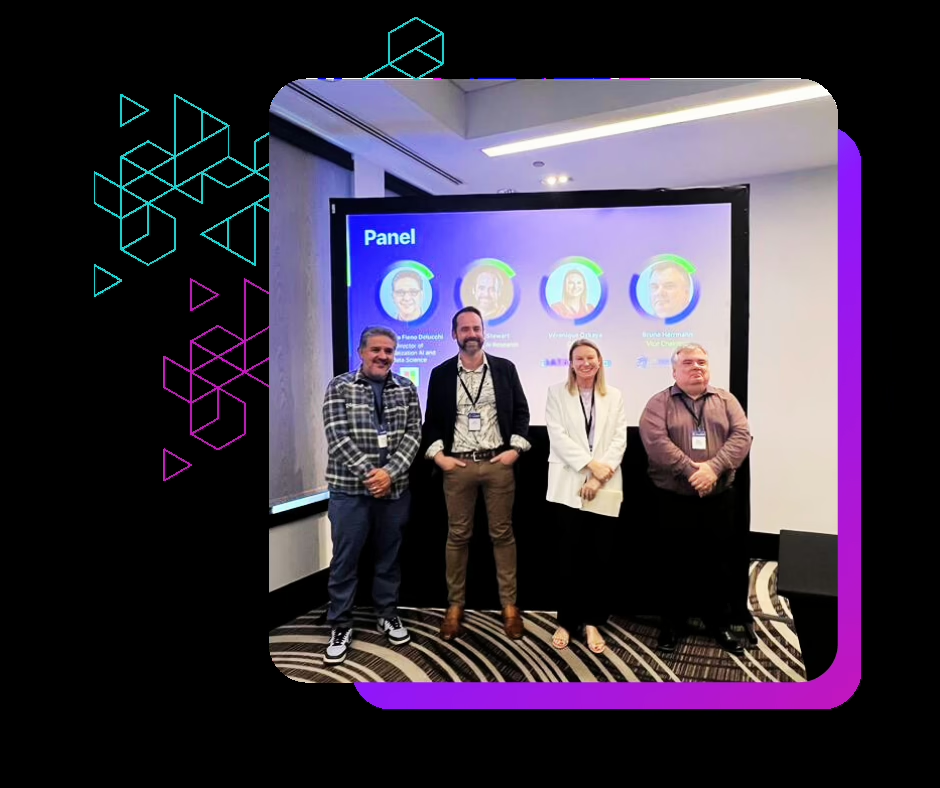
At Loc360 Seattle, industry leaders gathered to explore the intersection of language, AI, and data in a rapidly evolving content landscape. Following an inspiring keynote by Bruno Herrmann, a dynamic panel discussion brought together experts from across the localization and tech spectrum: Bruno Herrmann, Craig Stewart (Phrase), Veronique Ozkaya (DATAmundi), and Agustin da Fieno Delucchi (Microsoft).
Their message was clear — while AI promises extraordinary capabilities, its success ultimately hinges on human guidance, collaboration, and cultural intelligence.
Humans at the Helm of AI
The panel opened with a unifying thought: AI is not a standalone solution. It is a tool — designed by humans, for humans. As businesses adopt AI to create and scale multilingual content, it’s critical to remember that the finesse, empathy, and cultural nuance necessary for global engagement still come from people.
Language as Data: A New Frontier
“Language expertise is needed more than ever,” Bruno emphasized. Content is, at its core, structured data — and multilingual content is one of the most underutilized data assets companies possess. Translation memories (TMs), for instance, are not just linguistic artifacts; they represent brand voice, tone, and cultural resonance.
These repositories can be enriched and converted into high-quality training data for large language models (LLMs), enabling more accurate, brand-aligned AI output.
The Power of Collaboration: Linguists + Data Scientists
A recurring theme was the importance of cross-functional collaboration. Linguists and data scientists bring complementary strengths. Linguists, when involved in prompt creation, produce vastly different (and often superior) results compared to purely technical approaches. By working together, these experts can transform localization into holistic language management.
Veronique Ozkaya underscored the real-world impact of this collaboration: removing bias by adding context. In languages where gendered forms are applied to roles, vehicles, or objects, reframing content through gender-neutral phrasing and rich context creates more inclusive and effective communication.
Rethinking Content Quality: From “Good” to “Effective”
Traditionally, content quality has been measured through linguistic accuracy. But the panel challenged this standard. They proposed a shift toward effectiveness — how well the content performs in real-world conditions. Does it resonate with the target audience? Does it tell the story appropriately for each locale?
This pivot is especially important when scaling content. A translation might be grammatically perfect but still fall flat if it misses regional idioms, cultural references, or emotional triggers.
The Scalability Myth
Many executives believe that once content is machine-translated or AI-enhanced, it’s ready to deploy globally. The panel warned against this oversimplification. Scaling effectively means more than automation — it means value-driven scalability.
It’s not about how fast or cheaply content can be produced, but how well it performs in-market. The goal is engagement, not just efficiency.
Anchor Datasets and Evaluation Frameworks
To build scalable yet nuanced AI solutions, the panel encouraged using small, curated samples of content as anchor datasets. These anchors serve as benchmarks to evaluate AI output, ensuring alignment with brand standards, tone, and user expectations.
Seeing data as a two-way street — to both understand and be understood — is critical in this process.
Looking Ahead: Creating the Future Through Content
In closing, the panel offered a powerful reflection: the content we’re feeding into AI today becomes the lens through which future generations — and future AIs — will understand the world.
This calls for intentionality, quality, and human oversight at every stage of content creation, training, and deployment.
Join the Conversation
Want to go deeper? Don’t miss the first of our three-part webinar series with Bruno Herrmann, where we’ll explore Human Supervised AI and the future of content, language, and data.
Agenda:
- What does human supervision mean in the age of GenAI?
Jul. 23 – 9:00 AM PT| 12:00 PM ET
Click here to register
- How to Operationalize Your GenAI Plan
Sept. 17 – 9:00 AM PT| 12:00 PM ET
Registration link coming soon, follow us on LinkedIn and stay tuned!
- Infusing AI in your Ecosystem. How much to use? How far to go?
Oct. 22 – 9:00 AM PT| 12:00PM ET
Registration link coming soon, follow us on LinkedIn and stay tuned!